

By Miguel Ángel Góngora Meza, Evolution Treks Peru’s Co-Founder
Rainbow Mountain, or Vinicunca, is a striped ridge in the Vilcanota range, about 100 km (62 mi) southeast of Cusco. Its viewpoint sits at about 5,036 to 5,200 m (16,522 to 17,060 ft), depending on the source. That is higher than Dead Woman’s Pass on the Inca Trail, and higher than anything most visitors have ever stood on.
I started on the Inca Trail as a porter in 1996, and from 1998 I walked these very mountains as an assistant guide, when they were still white with snow. On Instagram, Rainbow Mountain looks like an easy day. In person it is a short walk at an altitude that doesn’t care how fit you are. I see the same ten mistakes there every season.
For 2027 trips: tours currently use the Pitumarca route, because the Chillihuani road bridge collapsed in December 2025. A temporary commission has collected the entry fees since June 2026, so fees can change. The Qoyllur Rit’i pilgrimage on the Ausangate side falls around 21 to 25 May 2027.

Rainbow Mountain at a glance
| Attribute | Value |
|---|---|
| Names | Vinicunca (Winikunka), Montaña de Siete Colores |
| Altitude | About 5,036 to 5,200 m (16,522 to 17,060 ft); Andina gives 5,200 m |
| Location | Pitumarca and Cusipata districts, Cusco region |
| From Cusco | About 100 km (62 mi), about 3 hours by road |
| Hike | 90 to 120 minutes up; 3 to 4 hours round trip with stops |
| Entry fee going into 2027 | About S/25 foreigners, S/15 Peruvians (some operators quote S/30) |
| Best months | May to October (dry season) |
| Full day | About 3:00 to 18:00 |
- Mistake #1: Going in your first 48 hours in Cusco
- Mistake #2: Thinking a horse or an ATV removes the altitude
- Mistake #3: Saying “I’m fine” at 5,000 metres
- Mistake #4: Dressing for the photo instead of the mountain
- Mistake #5: Expecting the Instagram colours, and missing the real story
- Mistake #6: Not checking which route is open
- Mistake #7: Treating the communities as scenery
- Mistake #8: Arriving without small soles
- Mistake #9: Choosing Vinicunca when another mountain suits you better
- Mistake #10: Stacking it before the Inca Trail
- Plan your day: route, timing and costs
- Rainbow Mountain FAQs
Mistake #1: Going in your first 48 hours in Cusco
The most common Rainbow Mountain mistake is booking it for your first or second day in Cusco. Cusco is at about 3,400 m (11,155 ft). The viewpoint is roughly 1,600 to 1,800 m higher. Your body needs time to adjust, and no amount of fitness replaces that time.
My advice
- Spend at least 2 to 3 nights in Cusco or the Sacred Valley before the hike.
- On day one, rest. Eat light, drink water and go to bed early.
- Do a gentle walk first: Sacsayhuamán or the San Blas hills are enough.
I tell the story of Sophie, a journalist who learned this the hard way, in my Inca Trail lessons.
Mistake #2: Thinking a horse or an ATV removes the altitude
A horse or an ATV saves your legs, but it does not lower the mountain. Horses stop below the final steep slope, so everyone walks the last stretch at about 5,000 m. ATVs get you there faster, which gives your body even less time to adjust.
| Option | Good for | Watch out for |
|---|---|---|
| Walk (90 to 120 min up) | A gradual pace that lets your body adjust; cheapest | The hardest effort, all above 4,000 m |
| Horse (about S/90 to 100 in late 2026) | Saving energy; the money goes to local families | Cold when sitting still; the final slope is on foot |
| ATV (quad bike) | Speed; adds the Red Valley side | Noise, dust, and arriving high too fast |
My advice
- A horse saves energy. You still need your 2 to 3 nights of acclimatisation first.
- Agree the horse price with the handler before you get on, and pay cash.
- Whatever you choose, walk the final slope slowly. Short steps, steady breathing.
Horse prices are those reported in late 2026, the latest available for 2027 trips. Confirm before you go.
Mistake #3: Saying “I’m fine” at 5,000 metres
At this height, hiding symptoms is the dangerous mistake. The CDC Yellow Book describes acute mountain sickness as headache with nausea, dizziness or fatigue. Confusion, stumbling or breathlessness at rest are signs of brain or lung swelling. Those are emergencies.
On the Inca Trail, I once watched a dehydrated hiker at Phuyupatamarca tell me “I can push”. We stopped him, checked him and took him down. He finished the trek the next day because he spoke up early. I tell that story in full in my Inca Trail lessons.
My advice
- Tell your guide about any headache, dizziness or nausea at once.
- Going down is the treatment. The CDC says symptoms usually improve after descending at least 300 m (984 ft).
- Oxygen buys time. You still have to go down.
- Ask a doctor about altitude medication before you travel.
- Check that your travel insurance covers hiking above 5,000 m.
On our treks, guides carry a first aid kit, oxygen, an oximeter, two-way radios and a satellite device. For the full plan, read our altitude sickness guide.
Mistake #4: Dressing for the photo instead of the mountain
Rainbow Mountain can go below freezing at dawn and burn you by mid-morning. Wind on the ridge is strong. In the wet months, Andina reports that snow can cover the peaks and block access.
My advice
- Bring layers: a warm jacket, a rain jacket, a hat and gloves.
- Bring sunscreen and sunglasses. The sun at 5,000 m is strong even when it feels cold.
- Carry at least 2 litres of water and snacks.
- Wear broken-in hiking shoes, not new boots or trainers with no grip.

Mistake #5: Expecting the Instagram colours, and missing the real story
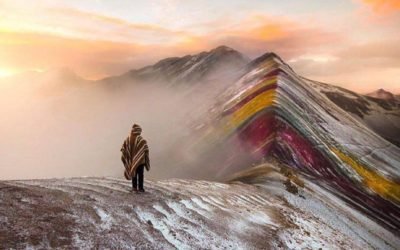
Many Rainbow Mountain photos online are heavily edited. In real life, the stripes are softer. They look brightest after light rain under sun, and cloud or snow can hide them completely. The bigger story is why the colours are visible at all.
My story: the mountains I knew in 1998
From 1998 to 2000, in my early years as an assistant guide, I walked this region again and again, for work and for my own spirit. In those years, most of these mountains were covered in snow. The glaciers were intimidating and magnificent.
The Qoyllur Rit’i valley, the Ausangate range and the Carabaya mountains beyond felt untouched. Herds of wild vicuñas grazed beside thousands of alpacas and llamas belonging to the local communities. Rainbow Mountain was not on any itinerary then. Its stripes were still under the snow.
Today the region has changed so much that it breaks my heart when I compare it with my memories. In August 2026, I walked the Sibinacocha side of Ausangate and met an old friend from the Crispín family. The first thing he told me was: “Miguel, our apu Ausangate is getting old.” He was trying to describe how fast the glaciers around us are melting.
What the data says
- The ice is going. Peru’s second national glacier inventory, by the national glacier institute INAIGEM, found that the country lost 56.22% of its glacier surface in about six decades, as reported in November 2023.
- The colours appeared as the snow melted. Rainbow Mountain only opened to visitors in 2016, after its snow cover disappeared.
- Mining is pressing on the same mountains. In 2018, a mining concession over Vinicunca caused public protests, and the company gave it up in May 2018. In 2019, eight more concessions covering 3,976.69 hectares were granted in Ocongate, Pitumarca and Checacupe districts, according to Actualidad Ambiental. They touch the Phinaya community’s land and the area of the Quelccaya ice cap, and they stalled a proposed Ausangate regional conservation area.
- These mountains are sacred. Qoyllur Rit’i, the pilgrimage below Ausangate, is described by Andina as Peru’s largest religious celebration. In 2018 the sanctuary expected about 600,000 pilgrims and visitors.
The colours themselves are real minerals. According to Andina, they come from marine, lake and river sediments raised by tectonic uplift and oxidised by weather. Red comes from iron-bearing claystones, green from phyllites and iron-magnesium clays, and mustard yellow from sandstones rich in sulphur minerals.
My advice
- Go for the place as it is, softer colours included.
- Look behind you. Nevado Ausangate, at 6,384 m (20,945 ft), is the apu, the protective mountain spirit, of these communities.
- When you share your photos, share the story too: the melting ice, the mining pressure and the families who live here.
- Travel in a regenerative way. Leave the place, and the people, better than you found them. That is what I try to do by telling this story.
Mistake #6: Not checking which route is open
Rainbow Mountain has two road approaches, and both have changed recently. Check which one your tour uses that week.
- Andina reported in July 2024 that the Cusipata access route had been closed since November 2023 over a management dispute. It reopened under a truce.
- On the night of 2 to 3 December 2025, the Chillihuani road bridge in Cusipata collapsed. According to Andina, tours switched to the Pitumarca route.
- On 29 June 2026, Andina reported that the Chillihuani community and the Llacto sector agreed to hand fee collection to a temporary commission. It collects fees until a new Transitional Tourism Committee is registered.
My advice
- Ask your operator which route and trailhead they use, and why.
- Check the news the week before you go.
- Expect fees and routes to shift while the new committee is set up. Confirm before you go.
Mistake #7: Treating the communities as scenery
Rainbow Mountain is the land of Quechua farming communities. Andina names Llacto, Qayarachimpa Chullo and Chillihuani at the foot of the mountain, with Tintinco and Paucarpata also involved. The Pitumarca route starts in the community of Qheshiuno.
Your entry fee, horse hire and photo tips are direct income for these families. The people in traditional dress with alpacas are at work, so a photo with them is paid. Pitumarca is also a weaving district.
My advice
- Ask before you photograph someone, and agree the tip first.
- Buy your snack or drink from the families at the trail, not only from Cusco.
- Learn two Quechua words: allillanchu (hello, how are you) and sulpayki (thank you).
Mistake #8: Arriving without small soles
Card payment is rarely possible on the trail. Entry, the Red Valley, horses, toilets and snacks are paid in cash. Large notes are hard to change at 5,000 m.
| Item | Price | Last checked |
|---|---|---|
| Vinicunca entry (foreigners / Peruvians) | About S/25 / S/15 (some quote S/30) | Nov 2026 |
| Red Valley add-on | S/15 to 30 | Nov 2026 |
| Horse to near the top | About S/90 to 100 | Nov 2026 |
| Palccoyo entry (foreigners / Peruvians) | S/15 to 20 / S/10 | Nov 2026 |
| Pallay Punchu entry | About S/10 | Nov 2026 |
My advice
- Bring S/10 and S/20 notes and coins.
- Check which fees your tour already includes.
- Keep some cash for your driver and guide. Our tipping guide has fair amounts.
Prices were last checked in November 2026 for the 2027 season. Confirm before you go.
Mistake #9: Choosing Vinicunca when another mountain suits you better
Vinicunca is the famous one, but it is not the only coloured mountain near Cusco. Palccoyo and Pallay Punchu are lower, shorter and quieter. From May 2026, Cusco’s regional tourism office promoted both as alternatives.
| Feature | Vinicunca | Palccoyo | Pallay Punchu |
|---|---|---|---|
| Highest point | 5,036 to 5,200 m | 4,900 m | 4,791 m |
| Walk to viewpoint | 90 to 120 min | About 1 hour | 45 to 60 min |
| Crowds | 1,000 to 2,000 a day at peak | Far fewer | Fewest |
| Drive from Cusco | About 3 hours | 2.5 to 3.5 hours | 4 to 5 hours |
Altitudes are from Andina (Vinicunca, Palccoyo) and cuscoperu.com (Pallay Punchu, which Andina gives as “more than 4,700 m”).
My advice
| Choose | If you… |
|---|---|
| Vinicunca | Want the classic view with Ausangate behind it and are well acclimatised |
| Palccoyo | Are short on acclimatisation or dislike crowds; its trail passes a “stone forest” of rock towers |
| Pallay Punchu | Want the quietest day, the “decorated poncho” slopes and the Langui-Layo lagoon nearby |
With children, heart or lung conditions, or pregnancy, ask your doctor first. The CDC says children are as susceptible to altitude illness as adults.
Mistake #10: Stacking it before the Inca Trail
Rainbow Mountain starts with a hotel pickup at about 3:00 to 3:30 am. The Inca Trail also starts before dawn. Putting them back to back means two nights of broken sleep before the hardest days of your trip.
My advice
- Leave at least one rest day between Rainbow Mountain and any multi-day trek.
- Use it as acclimatisation only after your first 2 to 3 nights at altitude, never before.
- If you want this landscape without one rushed morning, the Ausangate trek lets your body adjust over several days.
Plan your day: route, timing and costs
Most visitors reach Rainbow Mountain on a one-day tour from Cusco. According to Andina, the road runs south through Andahuaylillas, Quiquijana and Checacupe to Pitumarca, about three hours. From the Qheshiuno trailhead, Andina describes about one hour of walking to a horse station, then the steepest climb to the viewpoint.

A typical day
| Time | What happens |
|---|---|
| 3:00 to 3:30 | Hotel pickup in Cusco |
| About 6:00 | Breakfast in Cusipata |
| About 7:00 | Start walking from the trailhead |
| About 9:00 | Viewpoint and photos; optional Red Valley |
| Midday | Walk down and lunch |
| About 18:00 | Back in Cusco |
When to go
May to October is the dry season, with the clearest skies. June to August is the busiest. May, September and October balance weather and crowds.
Food on the way back
The road south of Cusco passes three food towns. Saylla is known for chicharrón (fried pork). Tipón, about 25 km (15 mi) from Cusco, is known for cuy al horno (oven-roast guinea pig). Oropesa is Peru’s “National Capital of Bread” under Law 31389 (2022), famous for its big round chuta loaves.
A festival in the same mountains
Qoyllur Rit’i, which Andina calls Peru’s largest religious celebration, is a pilgrimage to the Sinakara sanctuary at about 4,800 m (15,748 ft), on the Ausangate side of the range. According to Andina, pilgrims arrive for Trinity Sunday, and UNESCO inscribed it in 2011. Trinity Sunday falls on 23 May 2027, so the main days should be around 21 to 25 May 2027. Confirm with the organisers early in 2027.
For dates and inclusions, see our Rainbow Mountain tour. We keep groups to a maximum of 8 people.
Nevado Ausangate, the mountain behind the stripes
Nevado Ausangate is a 6,384 m (20,945 ft) glaciated peak in the Cusco region, southeast of Cusco city. It is the snow peak that rises behind Rainbow Mountain on clear days. Local communities honour it as an apu, a sacred mountain spirit.
It is reported to be the fifth-highest mountain in Peru.
| Fact | Detail (checked November 2026) |
|---|---|
| Summit altitude | 6,384 m (20,945 ft) |
| Circuit length | About 70 km (43 mi), usually 4 to 5 days |
| Trailhead | Tinqui, about 3,800 m (12,470 ft) |
| Highest pass | Palomani, reported at about 5,100 to 5,200 m (16,730 to 17,060 ft) |
| Best season | Dry season, about May to September |
The Ausangate circuit. The circuit loops around the mountain from Tinqui and ends near the hot springs at Pacchanta. It crosses two passes above 5,000 m (16,400 ft). It is one of the hardest treks near Cusco, so acclimatise first.
The Qoyllur Rit’i connection. The pilgrimage of the Lord of Qoyllur Rit’i takes place at the Sinakara sanctuary, in the Ausangate area of Ocongate district. The sanctuary sits at about 4,600 to 4,700 m (15,090 to 15,420 ft). UNESCO inscribed it as intangible heritage in 2011.
The pilgrimage begins 58 days after Easter Sunday, so in 2027 it falls in late May. Pilgrims usually walk about 8 km (5 mi) uphill from Mahuayani.
Best season. Trek from about May to September, when skies are clearer. The mountain makes its own weather, and snow or hail can fall in any month. Dates and conditions change; confirm before you go.
See our Ausangate trek to Rainbow Mountain for a guided route.
Rainbow Mountain FAQs
How high is Rainbow Mountain?
Andina, Peru’s state news agency, gives 5,200 m (17,060 ft). GPS-based sources give about 5,036 m (16,522 ft). Either way, it is higher than Dead Woman’s Pass on the Inca Trail (4,215 m).
How hard is the Rainbow Mountain hike?
The trail is short and non-technical, but the altitude makes it hard. Most people take 90 to 120 minutes up and about an hour down.
Is Rainbow Mountain worth it?
It is worth it if you are acclimatised and accept crowds. For the colours with less altitude and fewer people, Palccoyo or Pallay Punchu is a better day.
Can I ride a horse to the top of Rainbow Mountain?
Horses carry you most of the way, but not up the final steep slope. In late 2026 a ride cost about S/90 to 100, paid in cash to the handler. Confirm the 2027 price before you go.
How many days in Cusco before Rainbow Mountain?
We advise at least 2 to 3 nights in Cusco or the Sacred Valley first. Never go on your first or second day.
Can I do Rainbow Mountain without a tour?
Yes, but transport from the valley towns to the trailheads is irregular before dawn. A tour or private driver is the simpler choice.
What should I bring to Rainbow Mountain?
Bring warm layers, a rain jacket, a hat and gloves, sunscreen, sunglasses, at least 2 litres of water, snacks and cash in soles.
Before you go
The colours took millions of years to form. Seeing them safely takes a few days of patience, warm clothes, small change for the families who live there, and the honesty to say when you don’t feel well.
The ice that hid these stripes for thousands of years is disappearing within one lifetime, within mine. Respect the altitude and the people, and carry their story home with your photos. To plan a Rainbow Mountain day or the Ausangate trek, contact our Cusco team.
Updated: November 2026
0 Comments