
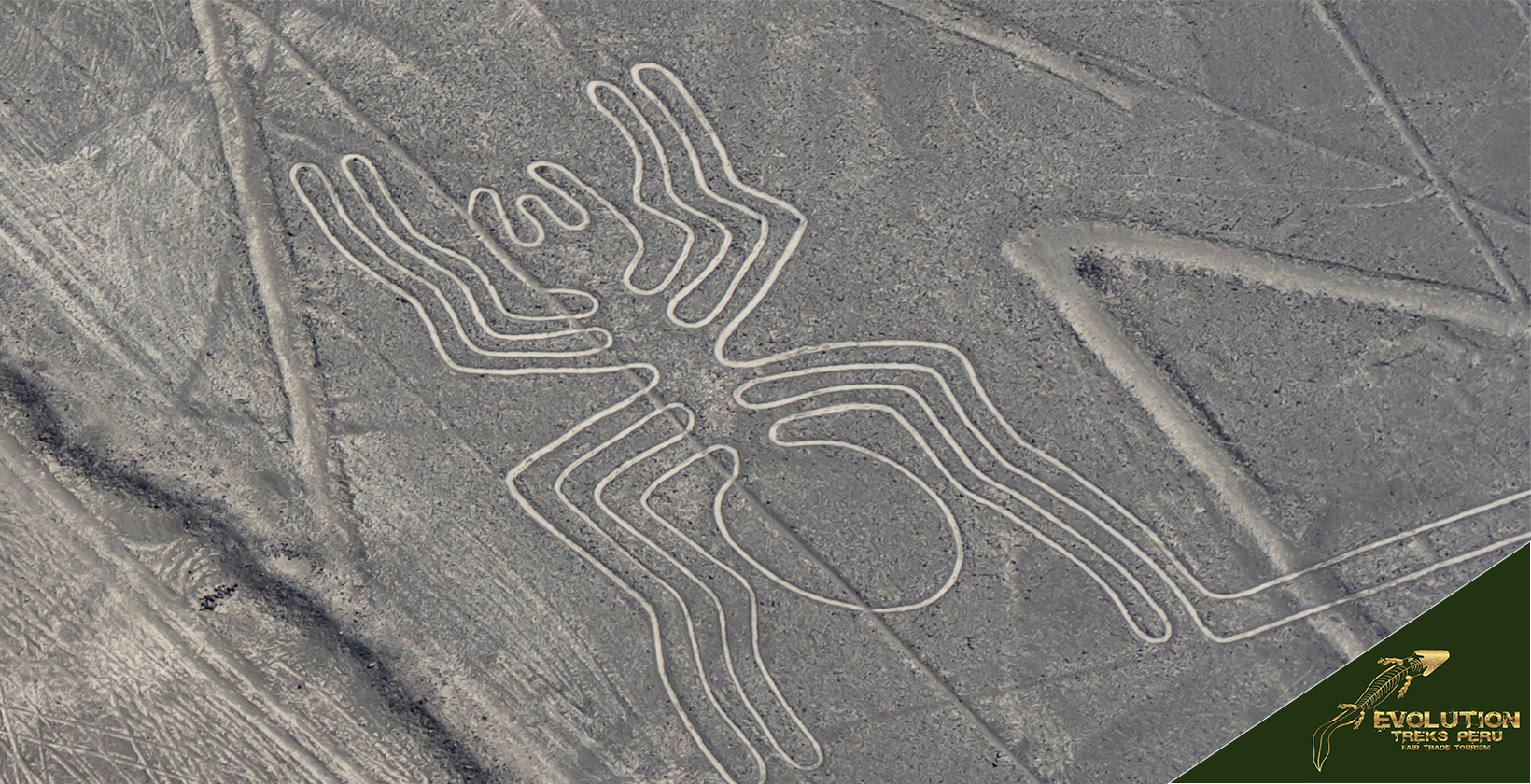

The Nazca Lines are ancient ground drawings (geoglyphs) in the Ica Region of southern Peru, about 450 km (280 mi) south of Lima by road. According to UNESCO, they cover about 450 km² and date from 500 BC to AD 500. The Paracas and Nasca cultures made them.
UNESCO describes them as the most outstanding group of geoglyphs anywhere in the world. It inscribed the site in 1994, and since 2016 it has been called “Lines and Geoglyphs of Nasca and Palpa”. By August 2025, 893 figurative geoglyphs were known, most of them found since 2019 with drones and artificial intelligence.
| Key fact | Value |
|---|---|
| Location | Pampas of Nasca and Palpa, Ica Region, Peru |
| Age | 500 BC to AD 500 (UNESCO) |
| Known figurative geoglyphs | 893 (August 2025) |
| Nearest town and altitude | Nasca, about 520 m (1,700 ft) |
| Distance from Lima | About 450 km (280 mi) by road, about 7 hours by bus |
| Overflight from Nasca | 30–35 minutes, about US$100–150 with fees (2026) |
| Ground viewpoints | Observation tower (a few soles), Mirador Natural (free), Palpa mirador |
| Time needed | 1 night in Nasca: flight in the morning, ground sites in the afternoon |
- What is new at the Nazca Lines in 2025–2026?
- What are the Nazca Lines?
- How many Nazca Lines figures are there?
- Who made the Nazca Lines, and why?
- What are the main Nazca Lines figures?
- What does a Nazca Lines tour include?
- Is it safe to fly over the Nazca Lines?
- How can you see the Nazca Lines without flying?
- Food, people and festivals of Nasca and Ica
- How do you get to the Nazca Lines?
- When is the best time to visit the Nazca Lines?
- How much does it cost to visit the Nazca Lines?
- What else can you see near the Nazca Lines?
- Nazca Lines FAQs
- Plan your trip to southern Peru and Cusco
What is new at the Nazca Lines in 2025–2026?
Four changes since 2025 affect a Nazca Lines visit. They are a fatal crash, wind suspensions, new AI-found figures and a fight over the reserve.
- 1 August 2026 crash: a sightseeing Cessna Grand Caravan from Pisco crashed near Nasca, killing all 13 people on board, according to RPP. The victims were 11 foreign tourists and 2 Peruvian crew. In a separate report, RPP said Peru’s transport ministry (MTC) suspended that operator as a precaution while the accident is investigated.
- Wind suspensions: on 24 August 2025, CORPAC halted flights at Pisco because of strong Paracas winds, as reported by Gestión. Nasca followed when dust cut visibility to 4 km. Build a spare morning into your plan.
- AI-found figures: in November 2025, Masato Sakai of Yamagata University told Andina that AI had helped find more than 500 new figures. He said the total could exceed 1,000.
- Reserve cut and reversed: at the end of May 2025, the Ministry of Culture cut the archaeological reserve by about 42%. After strong public criticism it restored the full 5,600 km² on 8 June 2025, as reported by AP.
The new figures are not open to visitors. No official source has announced public access to them.
What are the Nazca Lines?
The Nazca Lines are thousands of straight lines, geometric shapes and figures of animals, plants and humans drawn on the desert floor. The makers removed the dark, iron-oxide-coated surface stones and exposed the lighter ground beneath. The lines are typically 10 to 15 cm deep.
The geoglyphs fall into three groups:
- Straight lines: hundreds of lines that run across the pampa for kilometres, often crossing each other.
- Geometric shapes: trapezoids, triangles, spirals and zigzags, some of them hundreds of metres long.
- Figurative geoglyphs: animals, plants and human-like figures. The largest span about 370 m (1,210 ft).
The lines lie on the Pampas de Nasca, Jumana and Palpa, between the Ingenio and Nasca river valleys. “Nazca” is the common international spelling. Peru’s Ministry of Culture uses “Nasca” for the town, the province and the culture.
The lines have survived because the pampa is one of the driest places on Earth, with almost no rain and little erosion. The same stability means modern tyre tracks and footprints also last a very long time.
How many Nazca Lines figures are there?
By August 2025, 893 figurative Nazca geoglyphs were known, according to Andina. That total is the 430 known before 2024, plus 303 found in 2024 and 160 figurative finds in 2025.
Most new figures come from Yamagata University in Japan, led by archaeologist Masato Sakai. The team has worked in Nasca since 2004 with Peru’s Ministry of Culture, and with IBM since 2018.
| Year | Discovery | Method |
|---|---|---|
| 2016 | A 30 m many-legged mythical creature, central Nasca pampa (Majuelos sector) | Field survey |
| 2019 | 143 figurative geoglyphs, including the first found by AI: a small humanoid | Fieldwork, 3D data, IBM AI model |
| 2020 | A 37 m cat on the slope of the Mirador Natural | Found during viewpoint works |
| 2022 | 168 geoglyphs, mostly relief figures under 10 m beside ancient footpaths | Aerial photos and drones (2019–2020) |
| 2024 | 303 figurative geoglyphs in six months | AI-assisted survey, PNAS (September 2024) |
| 2025 | 248 geoglyphs (160 figurative, 81 geometric, 7 other), shown at Expo 2025 Osaka | AI and aerial images |
Andina reported in September 2024 that only about 30% of the pampa had been explored so far. The 2024 survey used remote sensing over about 400 km².
What did the 2024 AI study reveal?
The 2024 study in the Proceedings of the National Academy of Sciences (PNAS) identified two types of figure:
- Line-type geoglyphs are large figures drawn with lines. About 64% show wild animals, and they sit near the straight lines and trapezoids. The researchers link them to community rituals.
- Relief-type geoglyphs are small figures made by piling stones. About 82% show humans or domesticated animals, on average 43 m from ancient footpaths. They probably carried messages to people walking past.
Some relief figures depict human sacrifice, such as a 22 m killer whale holding a knife.
Who made the Nazca Lines, and why?
The Nazca Lines were made by the Paracas and Nasca cultures between 500 BC and AD 500, according to UNESCO. The Paracas made the earliest figures, many on hillsides in Palpa. The Nasca made most of the large figures and straight lines on the flat pampa.
The Nasca culture’s main ceremonial centre was Cahuachi, an adobe complex of about 40 mounds used mainly between AD 1 and 500. The Nasca are also known for polychrome pottery, trophy heads and underground aqueducts (puquios) that still carry water today.
How were the Nazca Lines made?
The makers removed the reddish-brown surface stones and piled them along the edges. They used wooden stakes and cord to lay out lines and to enlarge figures from small sketches. Remains of wooden stakes have been found at the ends of some lines.
What was the purpose of the Nazca Lines?
The purpose of the Nazca Lines is still debated, but most archaeologists link them to water, ritual and movement across the landscape.
| Theory | Main proponent | Current view |
|---|---|---|
| Astronomical calendar | Paul Kosok and Maria Reiche (1940s onwards) | Some lines align with solstice sunsets, but Anthony Aveni and Gerald Hawkins found too few alignments for a calendar. |
| Water and mountain worship | Johan Reinhard (1985) | Widely accepted: rituals asking for water in a desert fed by Andean rivers. |
| Ritual pathways | Several researchers | Deliberately broken pottery where lines intersect suggests processions along the lines. |
| Messages along trails | Masato Sakai et al. (PNAS, 2024) | Small figures beside footpaths spoke to travellers; large figures served community rituals. |
| Ancient astronauts | Erich von Däniken (1968) | Rejected by archaeologists; no evidence supports it. |
Who studied the Nazca Lines?
Peruvian archaeologist Toribio Mejía Xesspe made the first scientific study in 1927. On 22 June 1941, American Paul Kosok watched the sun set along one line and called the pampa “the largest astronomy book in the world”.
German mathematician Maria Reiche (1903–1998) then spent about 50 years mapping and protecting the lines. Her former home is now the Casa-Museo María Reiche.
What are the main Nazca Lines figures?
The main Nazca Lines figures are the Hummingbird, the Monkey, the Condor, the Spider, the Astronaut and the Hands. All are on the standard overflight route. The sizes below are the commonly published measurements.
| Figure | Size | Seen from |
|---|---|---|
| Hummingbird | 93 m (305 ft) long | Overflight |
| Condor | 134 m (440 ft) long | Overflight |
| Monkey | 93 x 58 m (305 x 190 ft) | Overflight |
| Spider | 47 m (154 ft) long | Overflight |
| Astronaut (Owl-Man) | On a hillside | Overflight |
| Hands, Tree, Lizard | Beside the highway; the Lizard is about 180 m | Overflight and observation tower |
| Cat | 37 m (121 ft) long | Mirador Natural (ground) |
The Hummingbird is one of the most photographed figures. In December 2014, Greenpeace activists left footprints beside it during the UN climate conference in Lima. Peru’s Ministry of Culture condemned the action and Greenpeace apologised.
The Monkey shows an animal of the Amazon, not the desert. It suggests the Nasca knew distant regions through trade or travel. The Astronaut has a round head and large eyes; its nickname comes from its look, not from any evidence.
The Pan-American Highway was built across the Lizard’s tail before the lines were protected. In 2009, heavy rain washed sand and clay from the highway onto three fingers of the Hands.
The Cat was announced by the Ministry of Culture in October 2020, after workers found it while improving the Mirador Natural. Its lines are 30 to 40 cm wide, and its Late Paracas style makes it older than most Nasca figures.
What does a Nazca Lines tour include?
A Nazca Lines tour usually means an overflight from Nasca or Pisco, or a land tour of viewpoints and nearby sites. The table compares the options available in 2026.
| Tour type | Duration | What you see |
|---|---|---|
| Overflight from Nasca | 30–35 min in the air | Up to 12 figures, including the Hummingbird and Monkey |
| Overflight from Pisco | About 1 h 35 min to 1 h 40 min | Main Nasca figures; saves the drive from Paracas |
| Nasca land tour | Half day to full day | Tower, Mirador Natural, Reiche museum, Cantalloc, Chauchilla |
| Palpa tour | Full day from Ica or Nasca | Older Paracas hillside figures from viewpoints |
Flights from Nasca leave from the María Reiche Neuman Aerodrome just outside town. The aircraft are small, and every passenger has a window seat. The pilot banks left and right over each figure so both sides get a view.
Before you book:
- Fly early. Winds are calmer and flights smoother before mid-morning.
- Bring your passport. Passengers are weighed to balance the aircraft.
- Eat lightly. Steep turns cause motion sickness; if you are prone to it, take medication 30 to 60 minutes before and follow the label.
- Allow a spare morning. Flights are held when wind, dust or haze reduces visibility.
Is it safe to fly over the Nazca Lines?
Flying over the Nazca Lines carries a real, documented risk, and travellers should weigh it before booking. The overflight industry has had several fatal crashes, the latest in August 2026.
| Date | Event |
|---|---|
| 2010 | Two fatal crashes, in February and October, killed 13 people in total |
| 4 February 2022 | A sightseeing Cessna crashed after take-off from Nasca; all 7 on board died |
| 1 August 2026 | A Cessna Grand Caravan from Pisco crashed near Nasca; all 13 on board died |
After the 2026 crash, Spain’s consulate in Peru advised Spanish citizens to avoid tourist overflights, according to La República (3 August 2026). It said the aircraft do not meet maintenance and safety standards equivalent to Spain’s.
Permits alone are not a guarantee. Peru’s tourism minister said the operator in the 2026 crash had its permits in order, according to a separate RPP report. In August 2026, Nasca’s Chamber of Commerce asked aviation authorities to close the Pisco overflight base; check whether Pisco departures have changed.
Honest notes before you fly
- Ask for the aircraft’s registration and the operator’s recent safety record, and do not choose on price alone.
- Two pilots and a safety briefing are good signs, but the 2026 aircraft also carried a pilot and co-pilot.
- If you feel unsure, see the Lines from the ground instead. The section below lists the viewpoints.
- The figures look smaller from the air than photos suggest, and turbulence makes many passengers sick.
How can you see the Nazca Lines without flying?
You can see several Nazca and Palpa figures without flying, from towers, hills and roadside viewpoints along the Pan-American Highway. You will not see the Hummingbird, Monkey or Condor this way.
- Observation tower (Mirador): a 13 m (43 ft) metal tower at about km 420, roughly 20 km north of Nasca. It shows the Hands, the Tree and part of the Lizard. Entry is a few soles in cash.
- Mirador Natural and the Nazca Cat: a small hill about 1 km south of the tower, with a free path to the top. It gives a close view of a long straight line and the 37 m Cat on its slope.
- Palpa mirador (Llipata): a roadside viewpoint near km 400, south of Palpa town in the Llipata area. It shows older Paracas hillside figures, including a group known as the Familia Real.
- Cahuachi: the Nasca ceremonial centre lies about 30 km west of Nasca, near lines on the pampa. Italian archaeologist Giuseppe Orefici excavated it for decades.
- Cantalloc and Ocongalla aqueducts: Nasca-era puquios with spiral stone wells, some still carrying water. Ocongalla lies past the aerodrome near the Cahuachi turn-off.
Buses and colectivos heading north from Nasca drop you at the tower in about 30 minutes. A taxi or a land tour is easier for Palpa, Cahuachi and the aqueducts.
Andina reported in December 2022 that the Ministry of Culture began restoring the 570 m Ocongalla aqueduct. Partners included the Asociación Internacional María Reiche and nearby communities. In 2022, Johny Isla Cuadrado, then director of the Nasca-Palpa management plan, said Palpa held more than 200 geoglyphs still to study.
Food, people and festivals of Nasca and Ica
Nasca’s food is coastal Peruvian: pollo a la brasa, lomo saltado, grilled meats and pisco sours. The wider Ica Region adds its own dishes, sweets and a March wine festival.
Where to eat in Nasca
Nasca is a small town, and most restaurants are in the centre, within walking distance of the Plaza de Armas. Expect pollerías for charcoal-grilled chicken, set-lunch menus and dishes such as lomo saltado.
Restaurants open and close often, and few publish prices. Check recent reviews and menus on arrival (2026).
What to eat in Ica
- Carapulcra con sopa seca: a stew of potato, ají panca and pork, served with sopa seca, noodles coloured with achiote. In January 2022, Ica’s regional government declared the Chincha version a typical dish of the region by regional ordinance, according to RPP.
- Tejas and chocotejas: filled sweets; the teja comes from Ica. Elena Soler started the Helena confectionery business in Ica in 1975, with a first shop behind the Luren church. According to Infomercado, she pioneered the chocoteja.
- Where to try them: look for carapulcra con sopa seca on menus in Ica and Chincha, and for tejas and chocotejas in Ica’s confectioners.
Vendimia: Ica’s grape harvest festival
The Festival Internacional de la Vendimia Iqueña is held in Ica every March, at the grape harvest. The 61st edition ran from 6 to 16 March 2026, according to Correo.
The 2026 programme included grape-stomping at the campo ferial on 6 and 7 March and the Gran Corso parade on 15 March. The 2027 dates were not announced at the time of writing; expect early to mid-March and confirm before you go.
How do you get to the Nazca Lines?
Most visitors reach the Nazca Lines by bus along the Pan-American Highway. Nasca’s aerodrome handles sightseeing flights only and has no scheduled passenger service.
| From | Time by bus | Route notes |
|---|---|---|
| Lima | About 7 hours | South via Pisco and Ica |
| Ica / Huacachina | About 2 hours | Frequent buses |
| Arequipa | About 9 to 10 hours | Mostly overnight |
| Cusco | 14 hours or more | Across the Andes, usually overnight |
A one-day trip from Lima by road is not realistic. Plan at least one night in Nasca, or fly from Pisco after a night in Paracas.
From Cusco to the Nazca Lines
The direct route from Cusco is an overnight bus of 14 hours or more across the Andes. The winding road crosses high puna before dropping to the desert, and many travellers find it tiring. Flying Cusco–Lima and taking the bus south is more comfortable.
From our base in Cusco, we suggest doing the coast first and travelling up to Cusco at 3,400 m (11,150 ft) afterwards. Read our guide to managing altitude sickness, then acclimatise with a Cusco city tour and the Sacred Valley. Then continue to Machu Picchu or the Inca Trail.
When is the best time to visit the Nazca Lines?
The Nazca Lines can be visited all year, because the Nasca desert is dry in every month. Time of day matters more than the month: book the first flights of the morning.
| Months | Conditions | For visitors |
|---|---|---|
| December–March | Hottest, sunny, clear | Good visibility; bring sun protection and water |
| April–May, October–November | Warm days, cooler nights | Comfortable for flights and ground sites |
| June–September | Mild days, morning coastal haze, Paracas wind | More delays, especially from Pisco |
The Nasca summer is the rainy season in Cusco. If you are combining both, see our guide to the best time to visit Machu Picchu.
How much does it cost to visit the Nazca Lines?
A Nazca Lines overflight from Nasca costs about US$100 to US$150 per person in 2026, including the aerodrome tax and the tourist ticket. Flights from Pisco cost about US$330 to US$410 with taxes and the tourist ticket. These are approximate 2026 figures; confirm before you go.
| Item | Approximate cost (2026) | Notes |
|---|---|---|
| Overflight from Nasca, 30–35 min | US$85–120 base fare | Often includes hotel transfer |
| Nasca aerodrome tax | About S/ 30–35 | Paid at the aerodrome |
| Overflight tourist ticket (boleto turístico) | S/ 47 | Also charged on Pisco flights since January 2025 |
| Overflight from Pisco, about 1 h 40 min | US$300–380 base fare | Pisco airport tax about S/ 70 extra |
| Observation tower | A few soles | Cash only |
| Mirador Natural | Free | Short walk up a hill |
| Chauchilla Cemetery | Small entry fee | Cash; also included in most Nasca land tours |
| Cantalloc Aqueducts | Small entry fee | Just outside Nasca |
Carry cash in soles. The aerodrome tax, tourist ticket, tower and smaller sites are paid in local currency.
What else can you see near the Nazca Lines?
The Nasca area has several sites that combine with the Lines in one or two days.
- Chauchilla Cemetery: a pre-Hispanic burial ground about 30 km south of Nasca, with mummies displayed in open tombs.
- Casa-Museo María Reiche: Reiche’s former home on the highway north of Nasca, with her instruments, a model of the lines and her grave.
- Cerro Blanco: a giant dune east of Nasca whose summit reaches about 2,078 m (6,818 ft) above sea level. It is a long, hard hike and a sandboarding run.
- Paracas and Huacachina: the Ballestas Islands and Paracas National Reserve lie further north, and the Huacachina oasis is about 5 km from Ica.
Are the Nazca Lines in danger?
The Nazca Lines are threatened mainly by vehicles, informal mining, farming and settlement on the edges of the reserve. In 2018, a truck driver left the highway and damaged three geoglyphs, according to the Ministry of Culture. Walking or driving on the pampa is prohibited, so stay on marked paths and viewpoints.
Nazca Lines FAQs
How old are the Nazca Lines?
The Nazca Lines are about 1,500 to 2,500 years old. UNESCO dates them between 500 BC and AD 500, when the Paracas and Nasca cultures lived on Peru’s south coast.
Can you see the Nazca Lines without flying?
Yes, partly. The observation tower shows the Hands, the Tree and part of the Lizard, and the Mirador Natural shows the Cat. The Palpa mirador shows older hillside figures. The Hummingbird and Monkey can only be seen from the air.
Is it safe to fly over the Nazca Lines in 2026?
There is a real risk: a sightseeing flight from Pisco crashed on 1 August 2026, killing 13 people. If you fly, check the operator’s record and fly early; if you are unsure, use the ground viewpoints.
How long is the Nazca Lines flight and how much does it cost?
A flight from Nasca lasts 30 to 35 minutes and costs about US$100 to US$150 with fees (2026). A flight from Pisco takes about 1 hour 40 minutes and costs about US$330 to US$410 with fees.
How many Nazca Lines figures are there?
By August 2025, 893 figurative Nazca geoglyphs were known, most found since 2019 by Yamagata University using drones, aerial images and AI. In November 2025, the team said the total could exceed 1,000.
Were the Nazca Lines made by aliens?
No. The Nasca people made the lines by removing surface stones with simple tools, and similar figures appear on their pottery and textiles. The alien idea comes from Erich von Däniken’s 1968 book and has no scientific support.
Can you do a Nazca Lines tour as a day trip from Lima?
Not by road, because Lima to Nasca is about 7 hours each way by bus. Stay one night in Nasca, or base yourself in Paracas and fly from Pisco.
Is Nasca at high altitude?
No. Nasca is about 520 m (1,700 ft) above sea level, so altitude sickness is not a concern. Cusco, by contrast, sits at 3,400 m (11,150 ft).
Plan your trip to southern Peru and Cusco
Evolution Treks Peru is a trekking company based in Cusco. Founder Miguel Ángel Góngora Meza started as an Inca Trail porter in 1996 and has guided since 1998. To combine the Nazca Lines with Cusco or a trek, contact us for route advice.
Updated: November 2026

0 Comments