
Empowering women in the Andean mountains of Peru
A few weeks ago, news that participants of the miss Peru pageant contest surprised the world by mentioning the numbers of the crude reality of domestic violence, rape and harassment toward women in Peru and the world, instead of the numbers of their body dimensions.
Such is the backdrop in which Evolution Treks Peru is launching a unique and powerful initiative, which is leading tours to the Inca Trail in 2018 supported by women porters and women tour guides.
Men overwhelmingly dominate the travel industry around the Inca trail to Machu Picchu. According to the Ministry of Culture of Peru, only 146 women compared to over seven thousand men registered to work as porters on the Inca trail. None of these women work actively, which means that these numbers are just figurative.
This endeavor has the potential of changing the way “sustainable travel” is perceived by the travel industry and force travel companies to be held accountable, as it exposes the real reasons why they never included women in this industry despite their labels about sustainability.
Tour operators do not hire women porters for two fundamental reasons.
Firstly, hiring women porters is not profitable.
From a business perspective, it is more convenient for travel operators to hire only men as they can carry more weight and demand fewer expenses in salaries food and transportation, which implicitly means more profit for tour operators. The Inca trail allows entry to only 500 people a day. Over 60% of them are porters. The rules for porters establish that men porters carry 20kg max, while women take 25% less than that.
Secondly, Having women porters would involve improvement of working conditions for porters in general.
An article exposing the working conditions of porters has been published recently. The logical conclusion to which one draws from that piece is that women porters would not be able to work under such abuse. Also, It would be more difficult for tour operators to hide their bad practices, as tourists would show more solidarity towards women if they saw women working in such conditions.
I am not implying that men do not receive the same level of empathy as women. They do, but what I mean is that perhaps a subtle patriarchal mechanism in peoples’ minds makes them praise the strength and courage of men, which in this case, partially blurs the mistreatment to which they are exposed.
Under poor working conditions for women, The solidarity of travelers with them would undoubtedly lead to more questioning of where the money travelers pay goes and how tour operators invest that money in the well being of their workers.
Consequently, all of it would force tour operators to change these things due to the outright anger and pressure coming from their clients.
Studies have shown that if women are working, communities prosper. It doesn’t make the community rely on men to work, it also upskills the women and gives them independence and financial freedom. All of which will assist in bringing down the brutal statistics of rape and domestic violence.
Supporting these kinds of projects is something every traveler needs to consider everywhere around the world. What a good place to start doing it while hiking the Inca Trail to Machu Picchu.
Evolution Treks Peru is taking the responsibility to lead the travel industry of peru toward a more sustainable path.
Where we are in 2026
Since 2017, Evolution Treks Peru has hired local Indigenous women as porters, at equal pay. We were the first company to hire women porters on the Inca Trail.
By 2024 we employed nearly 60% of all the women porters on the Inca Trail, while running fewer than 4% of its tours. Three of our first women porters became lead guides, and today 80% of our lead guides are women.
Our porters sleep in the same tents, on the same pads, as our clients, and carry ergonomic packs. Read more about our work for porters in Porter Lives Matter, or join a women-only Inca Trail tour.
Women porters aim to change the travel industry (2017)
A few weeks ago, news that participants of the miss Peru pageant contest surprised the world by mentioning the numbers of the crude reality of domestic violence, rape and harassment toward women in Peru and the world, instead of the numbers of their body dimensions.
As if this was not enough of an outrage, a movie depicting Andean women as dumb, illiterate, toothless and worthy of the laughingstock of the city dwellers has been recently released in the Peruvian cinemas, shining light on the hidden yet overt discrimination and racism to which Andean women are exposed on a daily basis.

As if this was not enough of an outrage, a movie depicting Andean women as dumb, illiterate, toothless and worthy of the laughingstock of the city dwellers has been recently released in the Peruvian cinemas, shining light on the hidden yet overt discrimination and racism to which Andean women are exposed on a daily basis.
It is these outrageous humiliating acts and statistics that have led Evolution Treks Peru to launch a unique and powerful initiative, aimed at empowering women in their local communities to assist in halting the terrifying statistics that we all heard at the Miss Peru Pagent.
Evolution Treks Peru will lead tours to the Inca Trail in 2018 supported by women porters and women tour guides. Men overwhelmingly dominate the travel industry around the Inca trail to Machu Picchu. According to the Ministry of Culture of Peru, only 146 women compared to over seven thousand men registered to work as porters on the Inca trail. None of these women work actively, which means that these numbers are just symbolic.
The endeavor of integrating women into a more active role in the travel industry of Peru has the potential of changing the way “sustainable travel” is perceived by local people, tourists, and business people. The ultimate goal is to transform the travel industry of Cusco and force travel companies to be held accountable for past and future labor practices, as it exposes the real reasons why they never included women in this industry despite their labels about sustainability.
Tour operators do not hire women porters for three fundamental reasons.
Financially, hiring women porters is not profitable. From a business perspective, it is more convenient for travel operators to hire only men as they can carry more weight and demand fewer expenses in salaries food and transportation, which implicitly means more profit for tour operators. The Inca trail allows entry to only 500 people a day. Over 60% of them are porters. The rules for porters establish that men porters carry 20kg max, while women take 25% less than that.
Socially, having women porters would involve improvement of working conditions for porters in general. An article exposing the working conditions of porters has been published recently. The logical conclusion to which one draws from that piece is that women porters would not be able to work under such terrible conditions. Also, It would be more difficult for tour operators to hide their bad practices, as tourists would show more solidarity towards women if
they saw women working in such conditions.
I am not implying that men do not receive the same level of empathy as women. They do, but what I mean is that perhaps a subtle patriarchal mechanism in peoples’ minds makes them praise the strength and courage of men, which in this case, partially blurs the mistreatment to which they are exposed. Indeed, what it means is that the same logic that prevents women from taking on this and other jobs is the same reasoning for why men are exposed to such horrible working conditions.
Indeed, what it means is that the same patriarchal logic that prevents women from taking on this and other jobs is the same reasoning for why men are forced to work under such horrible working conditions.
In a scenario where women are subjected to poor working conditions, the solidarity of travelers with them would undoubtedly lead to more questioning of where the money travelers pay goes and how tour operators invest that money in the well being of their workers.
Consequently, all of this would force tour operators to change these things due to the outright anger and pressure coming from their clients.
A change of this nature would not only benefit these female porters but the thousands of other male porters that work on the Inca Trail and other tourist destinations of Cusco. This would be a huge contribution that women would do to the labor rights of men in their fight to break from the ages-old traditional roles.
Ideologically, In societies like Peru, women are thought to be weak and incapable of performing jobs as porters due to their “weak nature.” Ideas like these exist unchallenged in the minds of both business owners and fellow male co-workers. The fact is that the women who already work as porters have proven these notions completely wrong.
Including women in this industry sets the foundations for further challenging these outdated ideas and allow us to progress toward a more inclusive world with less gender discrimination.
Studies have shown that if women are working, communities prosper. It doesn’t make the community rely on men to work, it also upskills the women and gives them independence and financial freedom. All of which will assist in bringing down the brutal statistics of rape and domestic violence. Supporting these kinds of projects is something every traveler needs to consider everywhere around the world. What an excellent place to start doing it while hiking the Inca Trail to Machu Picchu.
Evolution Treks Peru is taking the responsibility to lead the travel industry of Peru toward a more sustainable and inclusive industry.
Empowering women while trekking in the Andes (2017)
The Huchuy Qosqo Trek is a unique opportunity to trek on an off the beaten track location while empowering women to find emancipation and sustainable financial independence through their active participation in the tourism economic market.
At Evolution Treks Peru we believe in the fundamental role that women play in the life of the local Andean communities and the necessity to fully integrate them in the benefits of the tourism industry of Peru. We understand that gender discrimination in the workplace keeps women on the sidelines of the workforce and prevents half the population from enjoying the same rights as the other half.
Poverty levels in developing countries like Peru reach excessive levels amongst women, almost 70% of the world’s poorest people are women. Our belief is that by empowering women to be active members of the workforce that have been traditionally the realm of men, poverty rates could be slashed dramatically. That is why Evolution Treks Peru has made an unbreakable promise to the women of the communities we visit and does its part of empowering women to voluntarily participate in the travel industry doing the jobs that were once taken by men so they can enjoy its benefits. Evolution Treks Peru, together with the women of the Munay Chaska association of the native community of CCorcor have created a project to help these women work in the travel market.
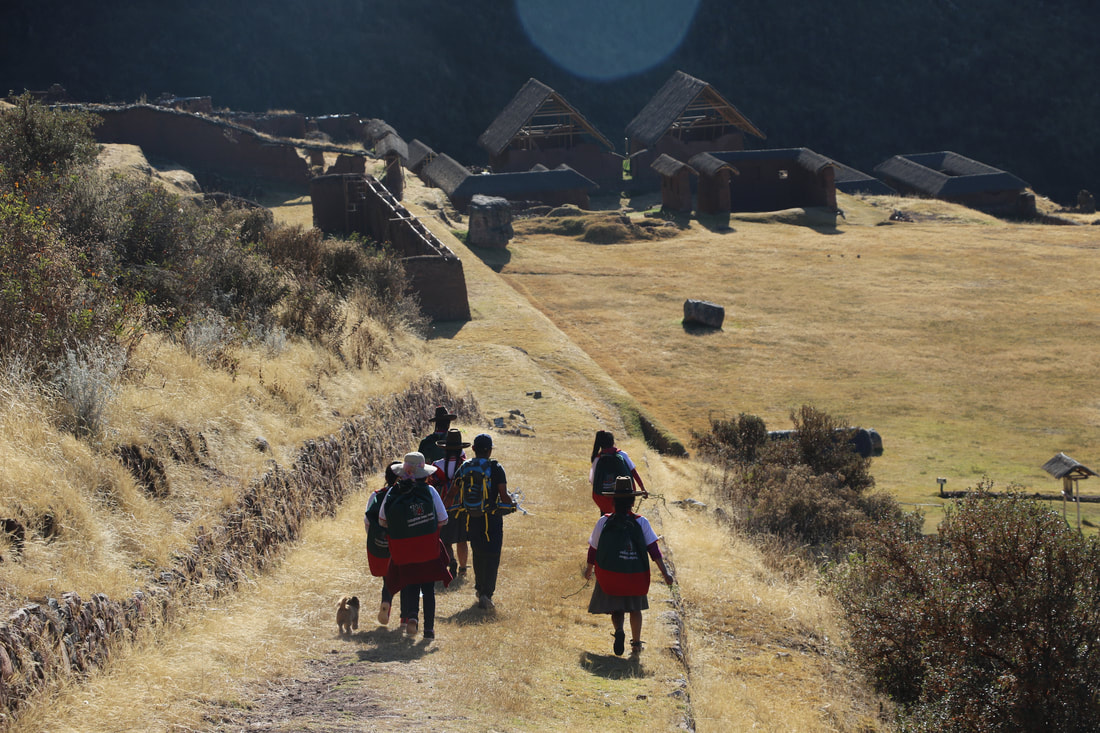
In this project, The women of Ccorccor have become the first ever women porters of Peru. Their job is to carry the camping equipment that tourists need in their trekking excursions to the Huchuy Qosqo archaeological site. Also, it is worth mentioning that all of our tours in this area are led by female tour guides as well. The women from Ccorccor are native Quechua speakers who were born and raised in this community. Besides getting a better than average salary from working with our company, the Munay Chaska Association as a whole will receive 30% of the profits that our business makes from operating our tours in this area, as established in our agreement of cooperation and empowerment of women.
The percentage of benefits that this community will receive will be used to fund the construction of tourist lodging facilities that they can autonomously manage. Once this project is fully operational and the business starts making profits, the community will reinvest this money in the education of their children, prevention of health problems as well as in other projects of farming and job creation for men to improve the living standards of the community members as a whole.
About the author.
Mikaela G Huaraya is a founding member of Evolution Treks Peru. She is an artist, a feminist, women rights’ activist, and animal lover. She works as the sales manager of Evolution Treks Peru.



0 Comments